


CASTLES AND CHÂTEAUX
Step into a world where time has stopped and where silent witnesses of the past still keep watch over the forest ridges. Lift the veil on the secrets of ancient castle ruins, romantic châteaux and manor seats standing guard over the Czech-Bavarian borderland. Bring to life the stories of knights, noble families and enduring legends written into the chilling beauty of weathered stone walls.
PŘIMDA CASTLE RUINS
The oldest stone castle in Bohemia. The ruins of Přimda Castle stand on the crest of a rocky ridge above the town of the same name in the northern part of the Český les. Přimda is first mentioned in 1121. The castle was most likely built by the German margrave Diepold II of Vohburg, but from 1126 at the latest Přimda already belonged to the Bohemian rulers as an important border fortress. It guarded the trade route from Prague and Pilsen to the Upper Palatinate and also served as a royal prison, where even Přemysl Otakar II, later king of Bohemia and a great military commander, was forced to spend time. In the 15th and 16th centuries the castle was frequently pledged to noble families, above all to the lords of Švamberk. Left without upkeep, it fell into decay, and by the 17th century it was already an uninhabited ruin. From the first half of the 12th century a massive square tower of quarried stone faced with granite blocks has survived. The castle is freely accessible, with no guided tours.
STARÝ HERŠTEJN CASTLE RUINS
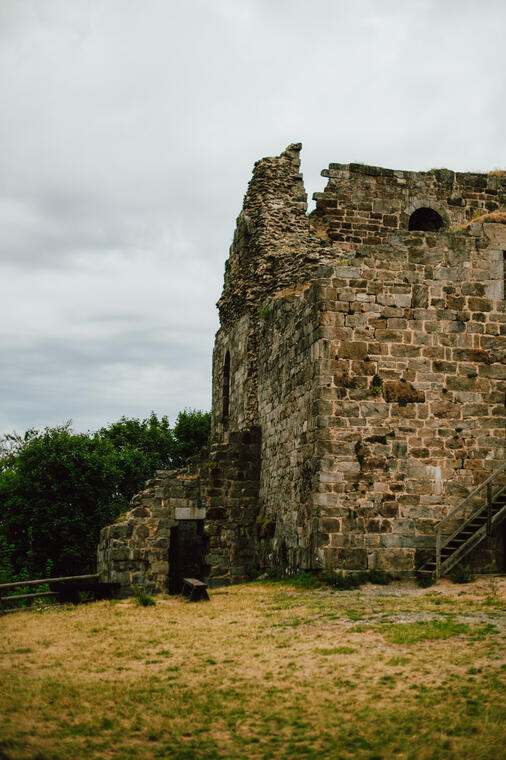
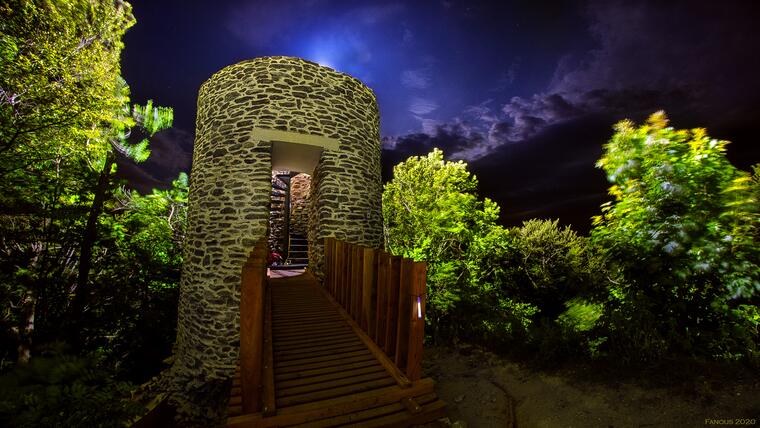
A romantic castle ruin deep in the heart of Český les, with a rich past and cruel fates that might have been lifted straight from the drama series Game of Thrones. Starý Herštejn is a castle ruin and lookout tower not far from Pivoň and the village of Rybník in Český les. The castle stands on the hill of the same name at an altitude of 878 m, surrounded by a nature reserve. The first written mention of it comes from 1272. The castle played an important role in protecting the church estates around Horšovský Týn. In 1421, during the Hussite wars, Herštejn was captured by the army of Domažlice.
According to legend, on Christmas Eve night, 24 December 1484, all the inhabitants of the castle were murdered here, women and children included. On their way back from the Christmas mass at the Pivoň monastery they were taken by surprise by the soldiers of the Palatine Elector Philip. Armed men who had managed to break into the castle. In 1506 Zdeněk Dobrohost z Ronšperka became the owner of the castle. The castle turned into a base for his raiding expeditions against the surrounding settlements and merchant roads. In 1510 the royal army captured and demolished the castle. The once important stronghold was never restored; only part of the round tower, remnants of masonry, ditches and ramparts have survived. Before 1989 the castle was inaccessible, there stood a military lookout post for observing the airspace above the state border and the border zone. You can reach the castle from Vranovské sedlo, where there is a car park and a rest area. From there you set off along the red-marked hiking trail.
The path, roughly 1.5 kilometres long, climbs gently over stony ground. A narrow, steep track then leads up to the lookout tower itself. You can also take a beautiful route from the village of Rybník along the red waymarked trail (the so-called Baar Trail), which is 7 kilometres one way. We recommend a stop at the local source of the Radbuza. The walk can be shortened by parking near the village of Závist, at the car park not far from the Radbuza spring. The whole route then measures a mere 4 kilometres one way.
THE MONASTERY IN PIVOŇ
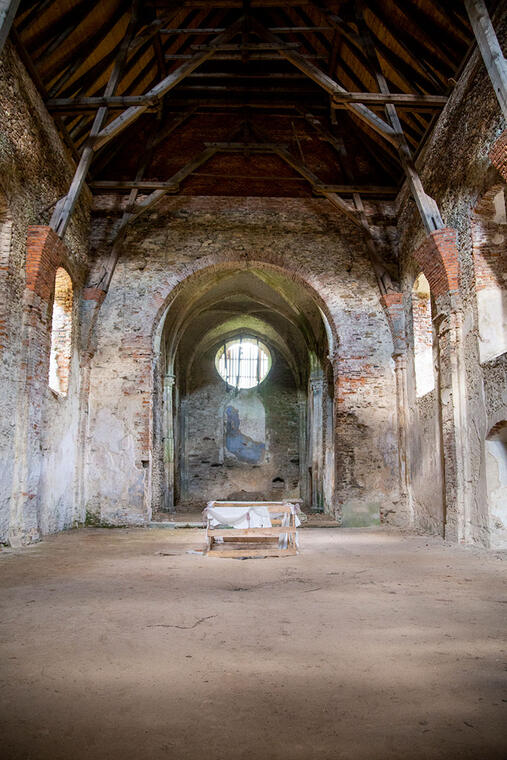
The hermitage at Pivoň was the first Augustinian monastery in Bohemia. The former Augustinian monastery stands in the village of Pivoň, roughly 5 km south-west of Poběžovice. Legend has it that the monastery was founded after 1040 to honour the victory of the Přemyslid duke Břetislav I over the Roman king and later emperor Henry III. Written sources, however, place its foundation in the 1230s, when it was established by the Order of Augustinian Hermits on the trade route from Prague to Regensburg.
The most interesting part of the monastery is the chancel of the single-nave Church of the Annunciation of the Virgin Mary, which is dated to the time the monastery was founded, that is to the middle of the 13th century. It is thus the oldest surviving part and is at the same time regarded as one of the oldest fully Gothic buildings in Bohemia. The nave of the church, by contrast, is Baroque. The rest of the complex is today made up of a group of multi-storey Baroque buildings erected around a rectangular inner courtyard that is left open on the north side. The southern farm range, extending westwards beyond the monastery precinct, was probably built after the monastery was dissolved in the 19th century. Parking is available by the complex.
HORŠOVSKÝ TÝN CASTLE AND CHATEAU
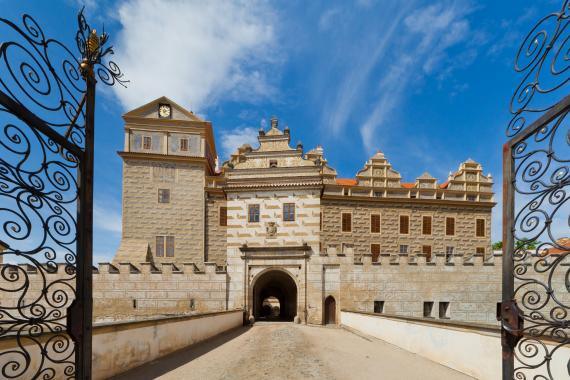
The national cultural monument of the State Castle and Chateau Horšovský Týn is among the most extensively opened-up sites in the Czech Republic. It is an important historical monument, situated in the town of the same name in the Plzeň Region. Originally built as a Gothic castle in the 13th century, it was owned by the bishops of Prague. After a devastating fire in 1547 it was rebuilt into a magnificent Renaissance residence by Jan the Younger of Lobkowicz.
The castle complex includes beautifully preserved interiors, extensive gardens and several churches, such as the Church of All Saints and the Church of St Anne. The grounds also offer a large park, ideal for leisurely walks and for discovering the natural beauty of the area. Today the chateau of Horšovský Týn is one of the most accessible historical places in the Czech Republic. It offers guided tours that present the rich history of the chateau and its architectural splendour. You can choose from several tour routes, including the chateau kitchen and the storage rooms. It is a national cultural monument and must be visited by everyone with an interest in Czech history and heritage. Parking is available on the square, right by the entrance to the chateau.
THE SVĚTCE RIDING HALL
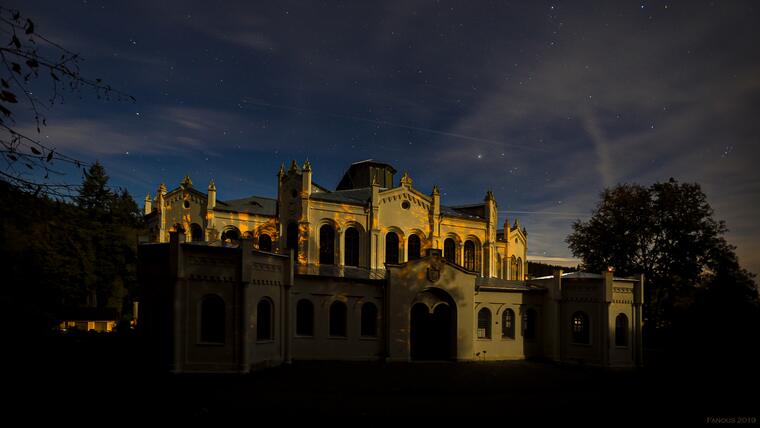
The second largest riding hall in Central Europe, a technical monument. Jízdárna Světce is a remarkable historic site near Tachov. Built between 1858–1861 by Prince Alfred I of Windischgrätz, the riding hall is an architectural gem in the Neo-Romanesque style. The original monastery was built in the 17th century, and after it was dissolved by Emperor Joseph II in 1787 it was acquired at auction by the then owner of the Tachov estate, Josef Mikuláš Windischgrätz. After Josef's death the estate was taken over by his son Alfréd, who began the rebuilding of the church and the construction of the riding hall. Prince Alfréd Windischgrätz died in 1862 while the work was under way, and his son Alfréd Mikuláš limited the project to completing the riding hall and conserving the already started conversion of the church into a chateau.
The riding hall fell into disrepair over time, and at the end of the 20th century its demolition was under consideration. Between 2000 and 2024, restoration work preserved the hall for future generations.
The building comprises a great hall with galleries, stables and living quarters, all decorated with intricate ornamental detail. Today the Jízdárna Světce riding hall hosts a variety of cultural events, exhibitions and weddings, and of course offers guided tours with excellent guides. Parking is available close to the monument. The riding hall is open at weekends; on weekdays the opening hours change with the season.
FLOSSENBÜRG CASTLE RUINS
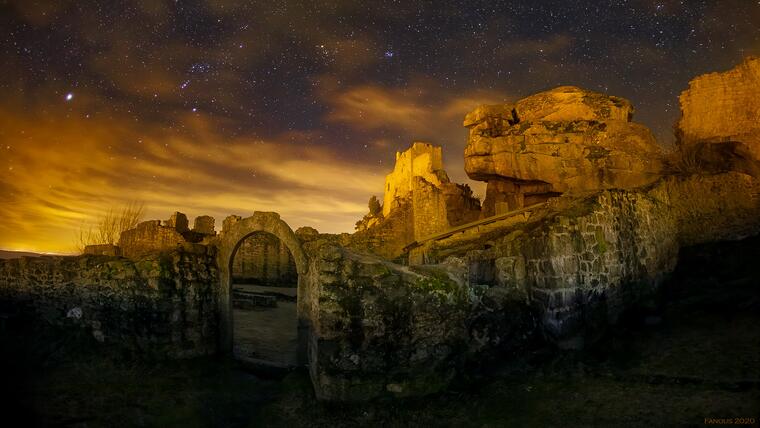
The castle ruin is a well-known and popular destination, above all for the sweeping view from the castle tower. The first written mention of Flossenbürg dates from 1125, when it belonged to Count Berengar I of Sulzbach. After the death of a later owner, the childless Count Gebhard II, the castle passed in 1188 to Emperor Frederick I Barbarossa. In 1212 Flossenbürg fell by inheritance to King Přemysl Otakar I, which was confirmed to him once again by a charter of 1231. Even so, in 1253 the castle was seized by Emperor Conrad IV, from whom it was obtained by his father-in-law, the Bavarian Duke Otto. Under an agreement with Přemysl Otakar II the castle became part of the possessions of the Bohemian Crown once more, but from then on it was frequently pledged by the Bohemian kings. In 1353 Charles IV bought Flossenbürg back from the Nuremberg burgrave John and his brother Albrecht.
In 1373 it passed as compensation to Frederick of Bavaria, and a year later Otto of Brandenburg received it in pledge. Although King George of Poděbrady succeeded in renewing his claim to the castle, as early as 1459 he gave it up again for lack of money. By the 16th century Flossenbürg was already considered a lost fief.
During the Thirty Years' War, in 1634, the castle complex was set alight by the retreating troops of Bernhard of Saxe-Weimar. That was when the castle finally lost its importance and became a welcome source of building material for the surrounding area. Over the years that followed it gradually fell apart. The castle is freely accessible all year round; parking is available in the car park in the centre of the village, 50 metres from the educational trail that leads up to it.
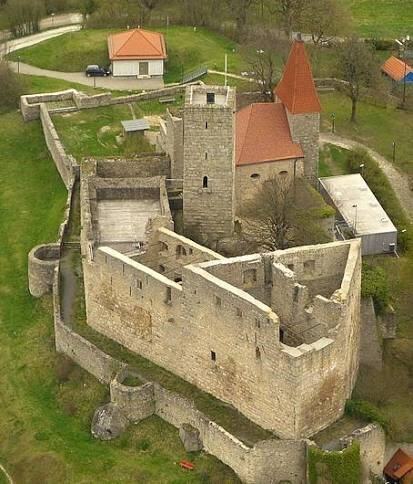
LEUCHTENBERG CASTLE
The largest and at the same time perfectly preserved ruin in the Upper Palatinate, standing right in the middle of the village. Today it serves as an open-air theatre stage. The castle was built around 1300 by an influential Bavarian noble family, the knights of Leuchtenberg. Some earlier fortification had probably already stood on the hill. The Leuchtenbergs abandoned the castle in 1322 and moved to nearby Pfreimd. The knightly house of Leuchtenberg died out in 1646. The castle was then left deserted and gradually fell into ruin.
In 1842 it was completely destroyed by a great fire. In the 20th century work began on securing what remained of the castle buildings and on rebuilding part of the castle. Today the ruin is open to visitors. In summer it serves as an open-air stage and is the venue of the annual Castle Festival in Leuchtenberg.
The little town of Leuchtenberg forms a unique landmark in the scenery of the Upper Palatinate. The castle is reached from the centre of the town, where you can park. The castle is open from April to the end of October, Wednesday to Sunday from 10.30 to 17.00.
KLADRUBY MONASTERY
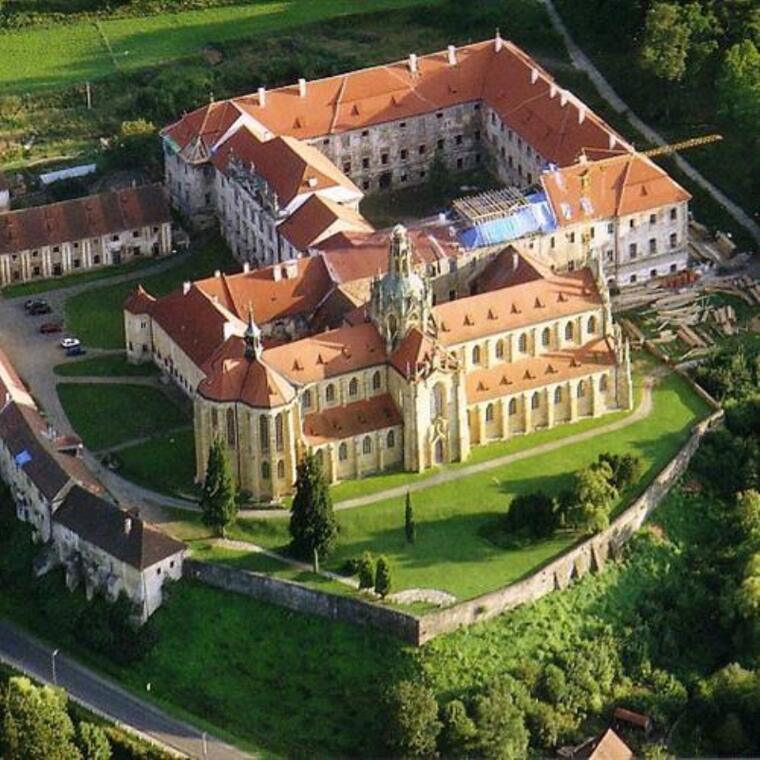
At the beginning of the 14th century it was among the wealthiest monasteries in the Bohemian Kingdom. Kladruby Monastery is a former Benedictine monastery located in the town of Kladruby, near Stříbro in the Plzeň Region. It has a rich history that reaches more than 900 years into the past. It was founded in 1115 by Duke Vladislav I. The monastery is known for its magnificent church of the Assumption of the Virgin Mary, which was rebuilt in the Baroque Gothic style by the famous Czech architect Jan Blažej Santini-Aichel. The church dome reaches a height of 46 metres and is crowned with a gilded Marian crown. Another important building in the complex is the New Convent, designed by Kilián Ignác Dientzenhofer.
The Kladruby monastery was an important religious, economic and cultural centre until its dissolution in 1785, during the reforms of Emperor Joseph II. Today it is a national cultural monument open to the public, offering guided tours that explore its architectural beauty and its historical significance.
The monastery offers two guided tours, is open all year round and hosts many cultural events.
Are you ready
to pay us a visit?