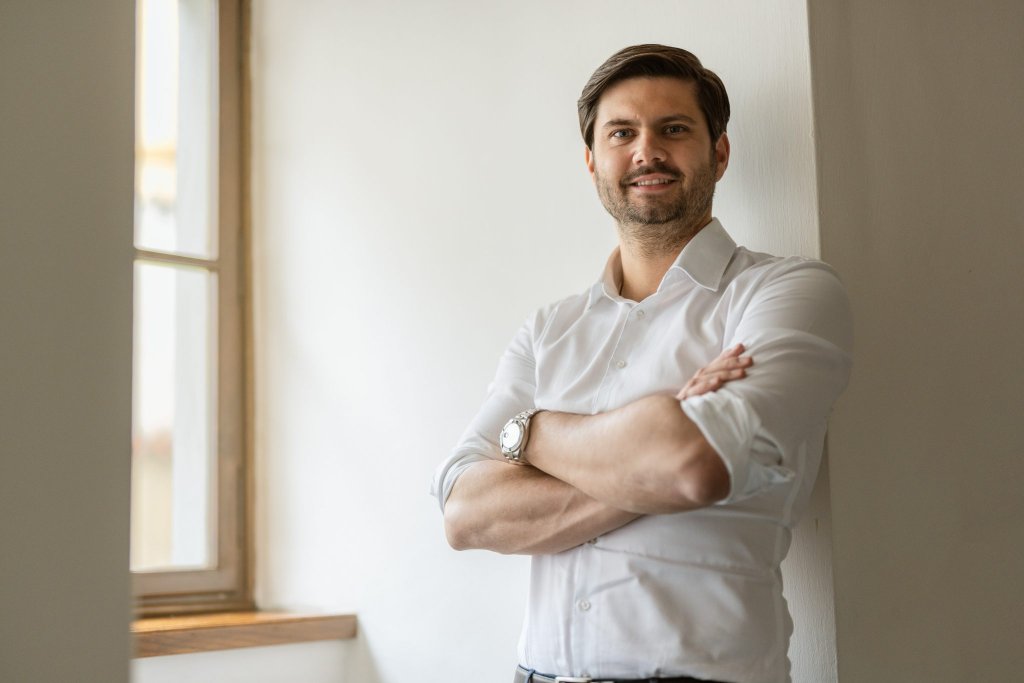



A surprising concept in a surprising place: that is one way to introduce Resort Český les, the work of the family investment group FKCG, a. s., owned by Ondřej and Jindřich Karhan, who created this gem for the most demanding of guests in the very place where their family roots lie. If we wanted to show a beautiful example of how a successful business can also serve the common good, here is one. The Karhan family did not take on this hotel project in order to expand their business activities, but above all to support the region around Český les and to draw tourism and attention to this beautiful natural area. And the guests they are competing for are not just anyone, but the most demanding of all. We appreciate their effort all the more, and we value the result. Ondřej Karhan, the younger of the Karhans, told us about all of this and about the history of the project in our interview.
Behind the Resort Český les project stands your investment group KARHAN GROUP. Is this its first project of this kind, or does it build on other investments in tourism?
This is our third project in tourism. We made our first hotel investment in 2018, when we bought the corporate-focused IBIS hotel in Plzeň from the French hotel chain Accor Group. We followed it with a project in Znojmo, stylish apartments in the town centre aimed at wine tourism. After several years of preparation and the reconstruction of a number of buildings, we opened Resort Český les in 2023 in Český les on the border with Bavaria. We also manage and run all of the projects entirely ourselves.
Why Český les? The location, that is?
My father has been in business in Český les since the early 1990s and has in effect spent most of his working life here. He is still active in retail with a focus on the German market. At the same time, he gradually built up the beautiful Srdíčko game park in Železná and the Smíření park on the site of a former chateau park dating from the era of the German nobility before the war. In 2014 we founded our family investment company together and devoted ourselves to developing other projects outside Český les, but as time went on we said to ourselves that it would be a shame not to build on my father's almost 35 years of work in Český les. The local market, however, is changing considerably, and we decided to realise a project in tourism, a field that is on the rise in undiscovered or little-known locations.
You present your portfolio yourselves as projects with room to grow. So what type of projects are they?
At present the portfolio holds ten projects, with the greatest degree of diversification that is still bearable from the point of view of effective management and control. Most of the portfolio consists of real estate projects, from a set of 200 rental flats in South Moravia to the hotels already mentioned; we continue in retail in the Český les area and in Železná Ruda in Šumava; we have invested in a company working in leather upholstery for the automotive industry and in two Swiss makers of luxury watches; and our latest project is once again in Český les, where after five years we obtained the building permit for luxury design villa houses in the vanished village of Pleš in the heart of Český les, on a total plot area of 63,000 square metres.
How do you assess them before you go in?
We are not a strategic investor with one dominant project to which further projects with synergy effects are added. Naturally we try to steer our portfolio in a certain direction, above all with a view to managing it and to the areas where we believe we have a competitive advantage and add value. I think that over the past decade we invested in projects that were fairly risky, mainly because of their location, and that lay outside the interest of larger investors, whom we cannot outbid on attractive projects. We invested in rental housing outside Prague and the regional capitals even before that segment boomed, we bought a hotel in the growing Plzeň industrial zone, we are among the first larger investors in tourism in Český les, and we invested in emerging Swiss luxury watch brands, a very traditional and competitive segment. Unsuccessful projects have not passed us by either, although there have been considerably fewer of them than successful ones. Now we want to concentrate on projects that fit in some way into our strategy and into the locations of our existing projects.
Your investment group is in fact a family business. How did that come about? And what is it like to build a company as father and son?
Our company came into being 10 years ago, in 2014, and it was more or less a coincidence. I studied abroad and then worked in various international companies, and I never thought I would go into business myself. My father ran his retail business with his partners and at home we never saw his company as a family business. Seen through today's lens, I regard that as an advantage: we had to find our own way to our family firm and were not bound by the past or by a clearly defined line of business. We simply chose the strategy of doing what we enjoy and where we see an opportunity. I am enormously lucky that I enjoy working with my father and that we have a level of trust in each other you will hardly find with ordinary business partners. Our company is a little punk: we went into relatively large projects without any prior knowledge, armed only with a vision of the future and an estimate of how the market would develop. In an investment company with a clearly defined strategy, or in a traditional family firm, that would not be possible. I see our willingness to take on quite a lot of investment risk and our great appetite for learning new fields as a major advantage. We still enjoy developing the company, and we will see where we move next and what chance brings our way.
Duty free shops feature at the beginning of your investments. Are they still part of the portfolio, or has their time already "run out"?
The duty free segment was the original main pillar of my father's business. Together with his partners he read the 1990s perfectly and, even without major connections, managed to obtain a licence to run retail sales in a duty-free zone. Luck played a big part in that, but it was combined with great entrepreneurial enthusiasm, readiness and hard work. From the stories I know it was a time of great entrepreneurial euphoria and excitement about having a business of your own, something that cannot be compared with today. Duty free effectively launched my father's successful business career, which he went on to extend into fuel sales and investments in other companies. Today the shops are operated under the Travel Free brand and their performance falls every year. You are probably right that this is a business that is "coming to an end". Society and customers have changed, and some areas of business simply disappear sooner or later. That is why we see the future in other segments, and those are the ones we try to focus on.
At the moment real estate seems to be the predominant type of investment. Why?
At present most of our investments are in the real estate segment, but we try to diversify within it as well. The portfolio holds projects in retail, residential housing, accommodation services and development. We concentrate on segments where we can offer clients our services, and we run most of our projects ourselves. That is the only way to achieve higher margins and profitability. So with real estate projects we do not aim solely at the growth of capital value, we also try to increase operating profit. My father is a builder by background who carried out most of the construction himself. I focus on the investment side, economics, management and operations. So we have longer-standing know-how in the real estate segment. We try to add more services, to scale the business model and to look for operational synergies.
How do projects such as Resort Český les fit into that? The Český les project is not a purely business model, it is also meant to bring development to the area. How was that decision made? Why are you so involved here?
Resort Český les fits into our long-term strategy for developing the Český les (Bohemian Forest) area, where we have long-standing ties, business relationships and history. That is not something you can build in a year or two, and we are drawing on more than 30 years of work in this location. In such a remote area it is hard to earn the trust of employees, the municipality, the non-profit sector and other organisations. We are convinced that this is our competitive advantage, built on long-term work and results. To a large extent, the Resort Český les project is also an investment of the heart: we are trying to give back to this area what it has given us over the years and how much it helped us build our business. The further projects we are preparing in Český les are real-estate in nature, and we believe that in the future we will be able to bring other investors on board here as well, both individual and institutional.
When you develop any new, undiscovered area, investors understandably worry about whether the place will work commercially. That is why it has cost us, and still costs us, a great deal of energy to convince the market and our guests that we have something to offer them. For that reason we are deeply involved in the project and do our best to give Český les as much marketing support as possible. Lipno, for instance, is a great example for us: local investors there have done an enormous amount of work since the 1990s, delivering beautiful projects and building a very appealing brand. Of course, Český les has no high mountains or large lakes, but the nature and the atmosphere here are so unique that they can appeal to a broad range of visitors from both the Czech and the German side of the border. We are very grateful for the support of the banks, which we value highly, even though this area is less familiar and therefore riskier for them too.
For me, Český les means a combination of fine dining and active relaxation at the „end of the world“. I picture your guest as a senior executive who loves champagne and Michelin-starred restaurants, but is so passionate about cycling that instead of Paris he takes his holiday in Český les. How do you see your guest?
After a year of operation, we see our guest above all as someone who loves peace and quiet, is looking for something new, and at the same time insists on quality accommodation, good food and other services. The Český les Protected Landscape Area was declared back in 2005, when conservationists already recognised how unique this territory is. Yet even after 20 years, in our view, the area has not been introduced to a wider range of travellers and tourists, mainly because of the absence of quality services. Today's guest is willing to pay as much for a holiday as they would abroad, but expects the service to match. That was the biggest problem in Český les. Now we can see that even Čerchov, the highest peak of Český les, is coming to life, with accommodation and new restaurants appearing there. The investor is the public sector, which has broad access to national and European subsidies and therefore greater financial strength. We have to convince the banks and invest mainly our own funds. Still, it is becoming clear that the Czech economy and household purchasing power keep growing, and that Czech travellers want to discover interesting places closer to home. The boom in cycling tourism plays into our hands too: our resort connects to roughly 770 kilometres of Czech and German cycle routes running through beautiful, quiet countryside without any big climbs.
We do, however, run up against the reality on the Bavarian side of the border: German tourists used to come to the Czech Republic mainly for the low prices, and accepted lower service quality in return. That is not just our problem; I think operators in the Czech-Austrian border regions are dealing with exactly the same thing. There is no other way than to convince foreign guests that we have something to offer them and that we can match or even beat the service quality of their home market. At the resort we can see that it is possible: already around 30 percent of our guests come from Western countries.
Your list includes a real treasure among champagne houses, De Venoge. That is unusual, it is a genuinely unique champagne. How did you manage to bring it in, and to a bar in the Sudetenland of all places?
We were looking for the ideal concept for our restaurant and concluded that we had to offer good food made from local ingredients, combined with a drinks list that would meet our guests' expectations and at the same time bring them something new, something not widely known on the Czech market. Since we have our own game preserve next to the resort, we serve fresh venison and fish, and round out the offer with ingredients from other producers in the Český les area. Our menu is built around the atmosphere and the character of the region, and we think that adding fine French wines fits that concept perfectly. We did not want a wine list spanning the whole world, so we focus solely on Czech and French wines, and from France mainly on Burgundy and Champagne. We travel to the Champagne region often ourselves and are always looking for new producers. That is how we came across the champagne house De Venoge, with its incredible history and, above all, the quality of its wines. We managed to establish a closer partnership, which with hindsight is almost amusing: De Venoge sells its wines mainly in major cities such as Paris, London or New York, and we negotiated their exclusive sale in Český les. It probably comes down to our passion for champagne, but also to the guaranteed quality of our service. From De Venoge we offer not only the wonderful Cordon Bleu core range, but also the Princes and Louis XV ranges. With Louis XV, De Venoge competes with wines such as vintage Dom Pérignon or Louis Roederer Cristal. We complement the list with Burgundies from the village of Vosne-Romanée. I do not think you can drink wines of this quality anywhere else in Český les. We hope our guests enjoy this selection as much as we do.
Was it hard to persuade your team to come and work in such a remote place? I am thinking above all of your head chef, who makes the best svíčková (beef sirloin in cream sauce) I have ever tasted. The whole menu and the standard of the kitchen are phenomenal.
I am not going to pretend that building the whole team was easy. We are still working at it and still adding people. You have to bear in mind that we are in an area with no historical tradition of tourism or hospitality. Many people commute to Germany for work or are employed in manufacturing plants in the industrial zones along the motorway. So we look for individuals who want to go against the current and work in a beautiful new environment, even though that means a big career shift and a job in the service industry. And we are talking about hospitality and gastronomy, a sector facing an extreme staffing crisis across the whole Western world. In the beginning we tried recruiting in Prague, but over time we replaced those hires with local colleagues, which is wonderful. Every single member of the team matters to us, and today I can say that they all come from the West Bohemian region and 90 percent of them directly from Český les. Our head chef lives about 5 kilometres from the resort, has extensive experience abroad, and it is nothing short of a miracle that we found him. Our general manager is a native of Domažlice too, lives a short distance from the resort and is the driving force behind the whole project. We are extremely glad to support local people and to show that excellent staff really can be found anywhere. If it works in the depopulated Sudeten part of Český les, then it can work absolutely anywhere.
How do you view the project now, two years after it was completed? Is it where you expected it to be?
First of all, we are extremely glad that we managed to complete the demanding renovation of both buildings, which would never have happened without my father. A project of this size is challenging in itself, and on top of that we ran into COVID, historic inflation, war, a sudden surge in energy prices and a staffing vacuum in the local market. It may sound odd, but today it feels like a miracle that we managed to carry out the renovation and get the whole project up and running within 3 years. We started in 2020 and fully launched in May 2023. None of it would have happened without the incredible commitment of the entire construction team and of our management, who poured a large part of their lives into Český les. I believe that in a few years we will laugh about it and Český les will be a favourite destination for a much wider range of guests, whether at our resort or with other operators who will hopefully arrive in time.
What are your plans for the future? More projects like this one?
This September we received the building permit for a beautiful, large project, Viladomy Pleš, right in the heart of Český les, designed by the architect Rajniš, and we have further plans. Everything will depend on demand from guests, and we would be glad to see other larger investors bring their projects to Český les as well. The way forward certainly lies in investment houses and apartments, which would bring in the capital that is needed. We are aware that most Czech mountain destinations struggle with a shortage of hotel projects at the expense of apartment developments. We have taken the opposite route: first we build the services and the infrastructure, and only then do we plan to offer investment properties as well. Given how few services Český les has, there was really no other way. We are certainly planning investments in other segments and areas too, so we will see where fate takes us.