



A new chapter for a forgotten region. A 200 million investment turned former barracks in Český les into a hotel
The Karhans, a family of entrepreneurs, set out to build a hotel with a bistro. What grew out of that original plan is a resort with a wellness centre, a bar and a restaurant drawing on the gifts of the surrounding forests.
The Český les region in western Bohemia, right on the border with Germany, is one of the few places in this country where you can walk through the landscape all day, even in summer, without meeting a soul. Deep woods hide in its hills, along with dozens of vanished villages whose names recall the area's rich glassmaking past. That rare quiet and singular atmosphere spoke to the entrepreneur Jindřich Karhan, who together with his son Ondřej invested in building a four-star resort on the site of former military barracks.
The glassmaking history of Český les reaches back to the 16th century, when the lords of Švamberk built the first furnaces here. The craft flourished most in the 18th and 19th centuries; besides the names of several villages, its importance is also evident in the name of one of the local summits, Sklářský (Glassmakers' Hill). The area had a whole range of schools and associations too, the region was economically prosperous and tourism thrived here as well.
Then came the Second World War and, after it, the expulsion of the German population, which had been numerous here. Once the Iron Curtain went up, the whole region turned into a dangerous borderland where wandering about on your own was not advisable. Four forbidding military installations were erected on prominent summits, allowing the communists to watch everything that happened in the area.

Exploring Český les, you often will not meet a soul.
After the expulsion of their inhabitants, the empty border villages began to decay, and all that survives of them today are foundations or fragments of walls lingering almost unnoticed in the landscape. In the village of Pleš you can even come across the remains of a church and a cemetery, now tended by people who travel here from Germany. Yet Český les has also kept a number of buildings from the last century. Take the military barracks in the village of Železná near Bělá nad Radbuzou, whose architectural language suggests they went up in the mid-1980s. In 2020 they were bought, together with the building of the former German school, by Jindřich and Ondřej Karhan, owners of the investment group FKCG. And they decided to turn them into a resort.
“Jindřich started discovering Český les some 30 years ago and fell in love with the place – there is really no other way here. And when the chance came to buy both buildings, he and his son agreed to go for it. They knew that in terms of return on investment it would be a long-distance run, but by then it had already become a matter of the heart for all of us,” explains Linda Schneiderwindová, managing director for hospitality within the FKCG investment group.
This is not the Karhans' first investment in the area. In the past, Jindřich Karhan had the Czech-German park Smíření (Reconciliation) built here, as well as a game preserve now home to fallow deer and red deer. Converting the original barracks into Resort Český les required an investment of almost 200 million crowns. A lower figure had originally been expected, but then the costs came to include solar panels and a heat pump, and the whole accommodation concept changed fundamentally as well.
“The building was designed for accommodation and catering, so turning it into a resort was not that difficult. The internal layout could stay practically unchanged, and the kitchen already had plenty of back-of-house space. Originally we thought we would create apartments and add a simple bistro alongside them. But during construction it got a little out of hand, and in the end we also have a large restaurant, a bar and a wellness centre here,” Schneiderwindová smiles.
For great food, champagne and whisky
In this corner of the country even an ordinary pub is hard to find. Which makes the Hvozd restaurant at Resort Český les feel all the more like an apparition. Its kitchen is headed by Martin Šiling, who previously worked at the Prague restaurant Zátiší, but then decided to change his field of action and head out into nature. That surrounding nature is exactly what the culinary concept here draws on. It is built on local meat, game, fish and dairy products.
“Martin brought us beautiful food and the vision that our relationship with nature can be written into the kitchen as well. We want to use mainly local products in order to support local producers. In time we would also like to try yak steaks, because a local farmer breeds them,” Schneiderwindová explains. The kitchen builds on simplicity and on dishes we all know well, such as dill sauce, venison in cream sauce or veal schnitzel. The menu is not overwhelming, and at the same time every dish lets the flavour of its main ingredient come through.
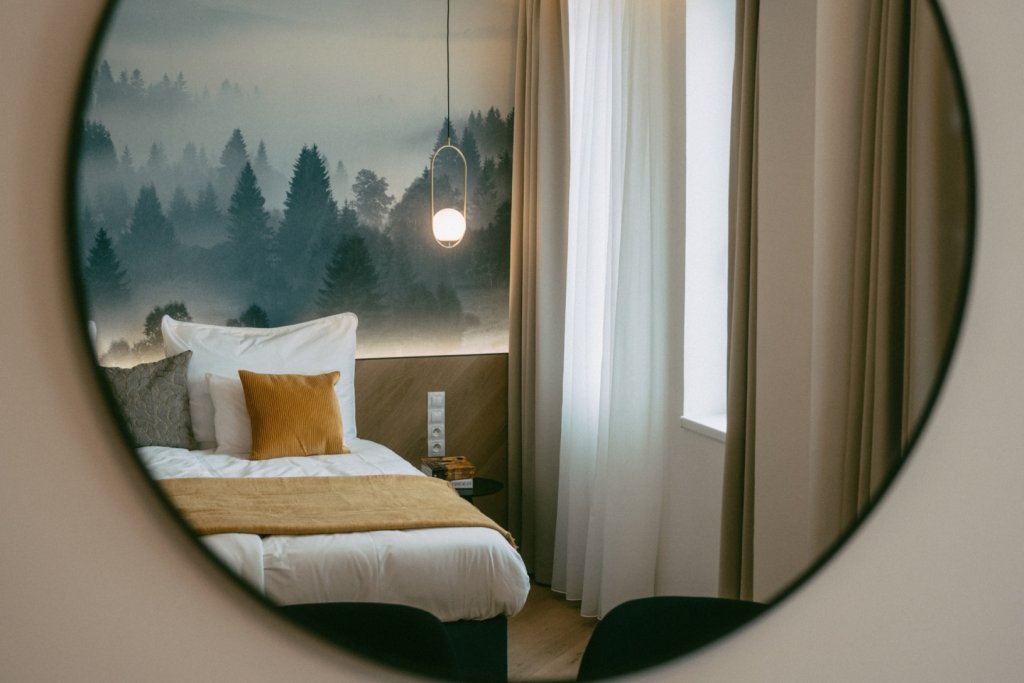
The architectural design is the work of Barbora Mluvková.
The bar in question, where De Venoge champagne and whisky take centre stage, sits in the resort's basement and goes by the name Kotelna, which according to Schneiderwindová has an entirely prosaic explanation: it occupies the site of the original boiler room. Traces of it are still visible in the interior, as the ribs of the old boiler hang on the wall and are also set into a free-standing stainless-steel structure that serves as a minimalist bar counter. “So we have 800 kilos hanging on the wall here, which was quite a puzzle to solve,” laughs Schneiderwindová.
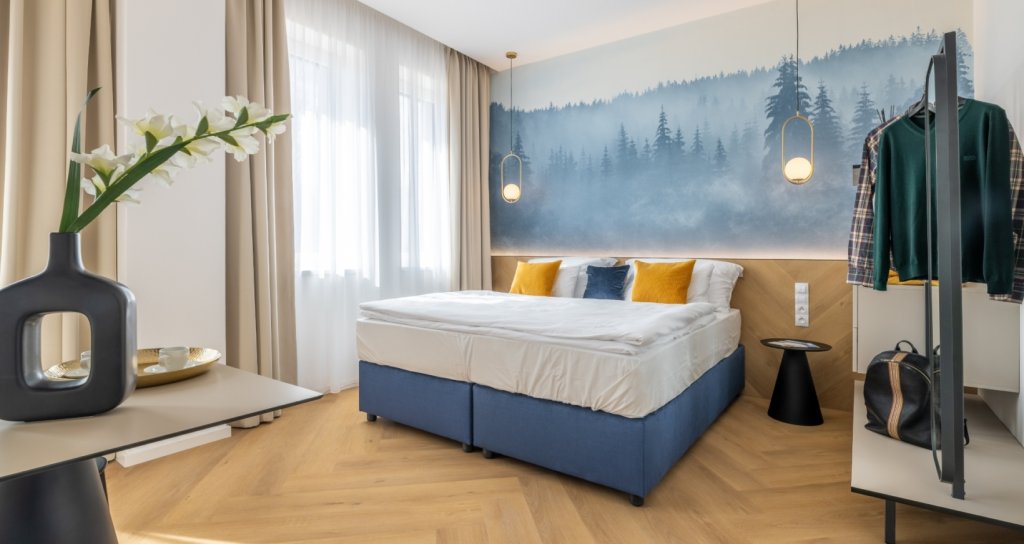
The resort's current look, including every interior solution, is the work of architect Barbora Mluvková and her Konceptual studio. She chose to draw her inspiration from the surrounding countryside, so a combination of wood, metal and glass, minimalist lines and a neutral colour palette runs through the whole space and every room. The rooms have the character of a design boutique hotel, and each one is complemented by a small kitchen. Above every bed the architect decided to place photographic murals with motifs of Český les (the Bohemian Forest) by photographer František Zvoneček.
The hotel is home to the Hvozd restaurant


The decoration in the room alone is an invitation to go out and uncover the secrets of the surrounding area. You can set off on foot or by bike, just be prepared for the hilly terrain. Schneiderwindová adds that in winter the region also has a reputation among cross-country skiers, provided enough snow falls. Alternatively you can head over to the German side to the Hohenbogen ski slope, which draws people from as far away as Plzeň.
Whichever activity guests choose, a cosy wellness area awaits them on their return, with a heated bench and infrared cabin as well as a properly hot dry Finnish sauna and a steam room. Add to that a plunge pool, a bucket of ice water for the brave and a Kneipp walk to get the circulation going in tired legs. “In the garden we are also planning an outdoor hot tub clad in wood, so that guests can unwind nicely in the evening, perhaps with a bottle of champagne,” says Schneiderwindová.
Accommodation in a First Republic school building
Those, however, are not the only plans the Karhan family has for the resort. Facilities for an open-air cinema are being prepared here, a lookout tower could rise next to the resort, and under the direction of architect Mluvková, renovation work is also under way in the former school building. Eight boutique apartments are to be created there, two of them easily accessible for people with reduced mobility. The attic will house a luxury apartment of 100 square metres.

“Český les is an extraordinarily peaceful place, but one that was badly treated in the past and from which life disappeared. We want to do at least a little to support the region, so we try to come up with activities for our guests that genuinely make sense in this setting. Together with the administrators of the Protected Landscape Area we have devised guided tours of the game preserve, for example, and we have set up an endowment fund through which we also want to give something back to the region,” Schneiderwindová concludes.
In the conference facilities in the basement of the resort there will be yoga classes, among other things, alongside team-building activities and other corporate events. Železná could thus become the first swallow to bring a breath of pre-war times back to Český les. Its history may be anything but cheerful, but it certainly does not deserve to be forgotten. Walking through the woods here, you also realise how few places with such a singular kind of calm are left in this country.